How Do You Specify Waterproof and Breathable Fabric for Woven Shells?
A woven waterproof and breathable fabric is a system, not a single finish. The face needs a durable water-repellent surface so liquid water does not wet out; a coating or membrane must resist liquid water under pressure; and a named breathability method must show that water vapor can still move through the structure. A spray rating alone, a hydrostatic-head figure without a test method, or a thick but vapor-tight coating is not a complete shell specification.
Key Takeaways
- DWR spray tests (AATCC 22 or ISO 4920) measure surface repellency. Hydrostatic-head tests (ISO 811 or AATCC 127) measure resistance to liquid water pressure. One result cannot replace the other.
- Breathability figures from JIS L 1099, ASTM E96 and ISO 11092 (RET) are not interchangeable; write the method and conditions next to the number.
- A coating can be enough for light rain or a modest shell. A laminated membrane is usually the more realistic route when the garment must keep a liquid barrier and a usable vapor path after washing and flexing.
- Adding film or coating thickness can raise hydrostatic head, but it often reduces breathability and stiffens the hand.
What does waterproof and breathable fabric mean in a woven shell?
It means three jobs are done at once, usually by different parts of the cloth: the face should shed liquid water, a barrier should resist liquid water under pressure, and water vapor from the wearer should still be able to leave.
The woven face — typically polyester or nylon filament — provides strength, weight and appearance, but it is not a waterproof barrier by itself. A compact or calendered weave can slow water down; apparel-level liquid resistance almost always depends on a coating or membrane plus a maintained DWR. Breathability is also not moisture wicking. Wicking moves liquid along fibers; a waterproof-breathable barrier has to pass vapor without opening a path for liquid water.
This guide is for clothing factories, brands and fabric buyers specifying woven polyester or nylon shells, not knit softshells, cotton, linen, silk, or film sold on its own.
Related product categories: Waterproof Polyester Fabric and Breathable Fabric.
How is hydrostatic head different from a DWR spray rating?
A DWR finish makes the woven face harder to wet. Spray tests such as AATCC 22 and ISO 4920 rate how water beads on that surface. A wetted-out face feels cold and blocks vapor even when the membrane underneath is intact, so a high spray rating is not a hydrostatic-head result and is not enough to call the cloth waterproof.
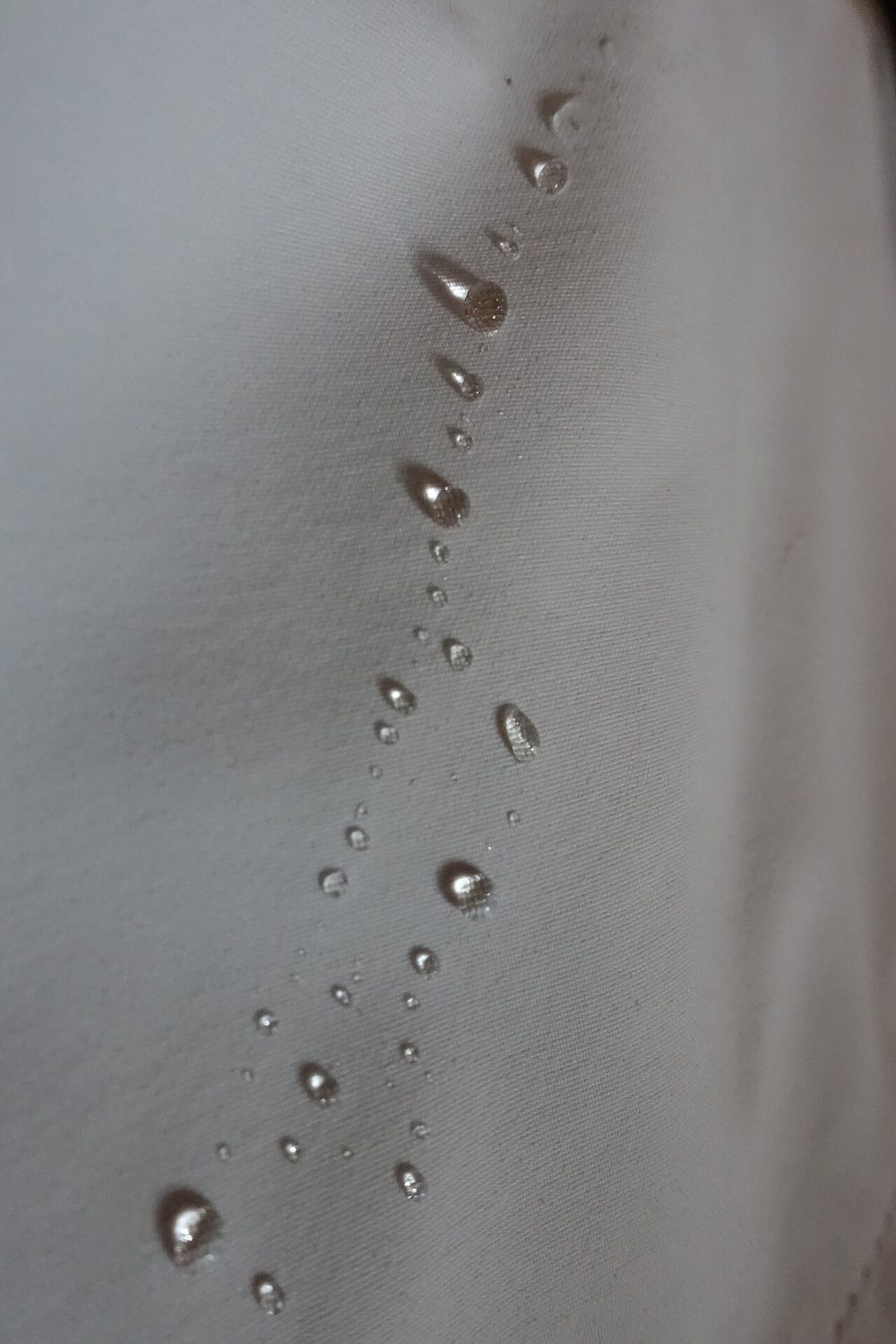
Water beading on a fabric after a water-repellent treatment. Photo: Fanny Schertzer, CC BY-SA 4.0, via Wikimedia Commons; resized.
Hydrostatic head, commonly run to ISO 811 or AATCC 127, measures how much liquid-water pressure the fabric system can resist before water passes through. The number only means something when the method, pressure mode, side tested, and any wash or abrasion conditioning are written beside it. Marketing shorthand such as "10K" or "10K/10K" cannot be compared if the figures came from different methods or different conditioning.
DWR also changes with washing, abrasion and contamination from oils or surfactants. A fluorine-free, C0 DWR can be specified where a PFAS-free package is required, including chemistries such as Rudolf fluorine-free DWR, but wash durability should be agreed as a test condition, not assumed to match older fluorinated finishes. Certifications including GRS, BCI, OEKO-TEX Standard 100, GOTS, and PFAS-free compliance are arranged per order and completed before shipment, without affecting delivery time.
Related reading: how DWR compares with other functional finishes on woven polyester and nylon.
Why can't you compare breathability numbers from different test methods?
The methods do not measure the same path under the same conditions. JIS L 1099 and several ASTM E96 setups report moisture vapor transmission rate (MVTR), usually as grams per square meter per day. ISO 11092 reports evaporative resistance (RET); a lower number means less resistance. An upright cup, an inverted cup, a potassium-acetate method and a sweating-guarded-hotplate test can rank the same fabric differently.
Write the method, temperature and humidity, fabric orientation, and any wash or flex conditioning next to the number. Two "10,000 g/m²/24 h" claims are not automatically equal. A laboratory result on a flat, new specimen will also not rescue a shell whose face is saturated in rain.
Related reading: how to read water-resistance and other results on a fabric test report.
When is a coating enough, and when do you need a laminated membrane?
A coating is a polymer layer, often PU or TPU, applied to the woven cloth. Extra thickness can raise liquid-water resistance, and this route can be enough for light rain, wind, or a program that does not need a stable vapor path after repeated washing.
A laminated membrane is a film bonded to the face fabric, and sometimes to a backer. It is usually specified when the shell must keep a continuous liquid barrier and a usable vapor path as a worn garment, not only as a new, unflexed panel. Dyeing, coating, lamination and other finishing are arranged with partner mills, not as in-house finishing.
The choice is a trade-off. Coatings are often more economical, but they can crack, peel or lose breathability if they are too thick or asked to perform like a 3-layer rain shell. Membranes add process steps, stiffness and cost, and still fail if bonding is weak, the face wets out, or the backer is wrong for the garment.
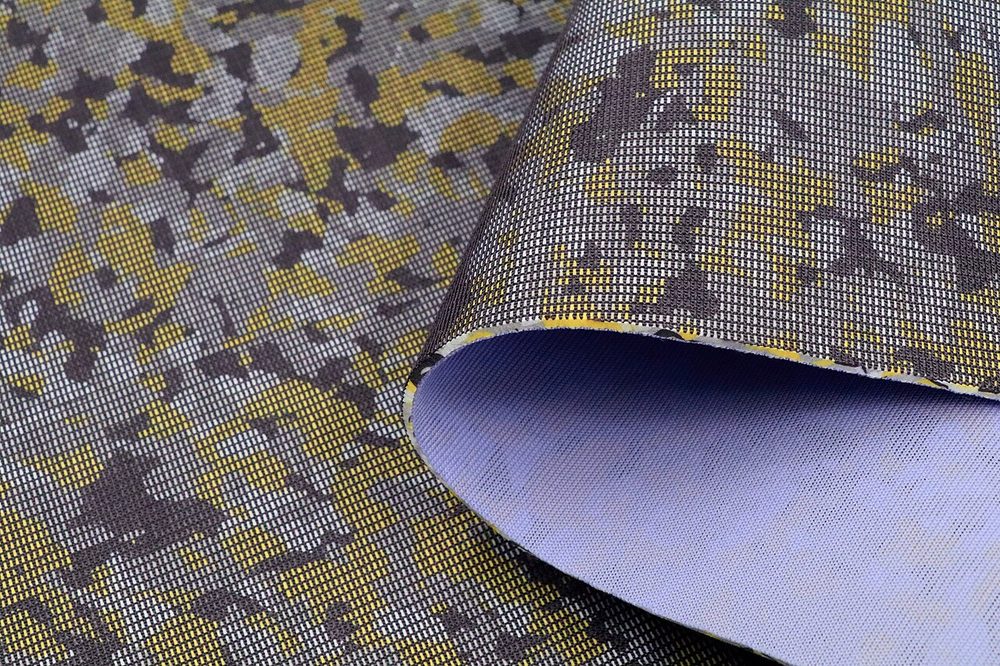
A woven face fabric bonded to a backing layer, folded back to show the laminate. This sample is a foam-backed example of a bonded construction, not a waterproof membrane. Photo: One2tree, CC BY-SA 4.0, via Wikimedia Commons; resized.
Related product category: Coated Fabric.
| Route | What it is | More suitable when | Main trade-off |
|---|---|---|---|
| Coated woven (PU or TPU) | A polymer layer on the cloth | Light rain, wind, or a modest shell | Thickness can raise water resistance but reduce handle and breathability |
| Microporous coat or film | A layer meant to block liquid water and pass vapor | Mid-range shells between a simple coat and a full laminate | Pores can clog; the name is not a test result |
| Hydrophilic monolithic membrane | A continuous PU or TPU film that moves vapor by diffusion | Shells that need a continuous liquid barrier plus a vapor path | The film must stay continuous; a wetted face can still feel clammy |
| 2L / 2.5L / 3L laminate | Face bonded to a membrane, with a lining, scrim, or bonded backer | Rainwear and outdoor shells that will be washed and flexed | 3-layer is usually more durable, but heavier, noisier and more costly |
Related reading: how to choose a PU coating type for woven polyester and nylon.
Send the end use, the hydrostatic-head method you want on the report, and any breathability method you already use, and we can check whether a coated or laminated woven construction is the more realistic route.
We are Hangzhou Six Dragon Textile Co., Ltd., a one-stop woven apparel fabric supplier (OEM & ODM). This site focuses on high-end functional synthetic woven apparel fabrics. Laboratory testing and QC are in-house; dyeing, printing and finishing, including coating and lamination, are partner or outsourced processes.
What changes between 2-layer, 2.5-layer and 3-layer constructions?
Layer count describes how the membrane is protected, not a waterproof score. A 2-layer build typically needs a separate lining; a 2.5-layer build adds a printed pattern or light scrim so a full lining is not always required; a 3-layer build bonds a backer to the membrane and is usually more durable to sew, at the cost of weight, stiffness and noise. Two "3-layer" fabrics can still differ widely in test results and peel strength, so attach methods, a peel or flex requirement if needed, and the wash route.
Expert Analysis
Why does face wet-out undo a good laboratory breathability result?
A membrane or coating can move vapor only if vapor can reach it and leave again. When DWR is worn away, or the face is contaminated with oils, detergents or residues, the woven face soaks up rain and becomes a cold water film. Vapor then has to diffuse through liquid water before it reaches the barrier, so the garment feels clammy even if an earlier MVTR or RET test on a dry, unwashed specimen looked acceptable.
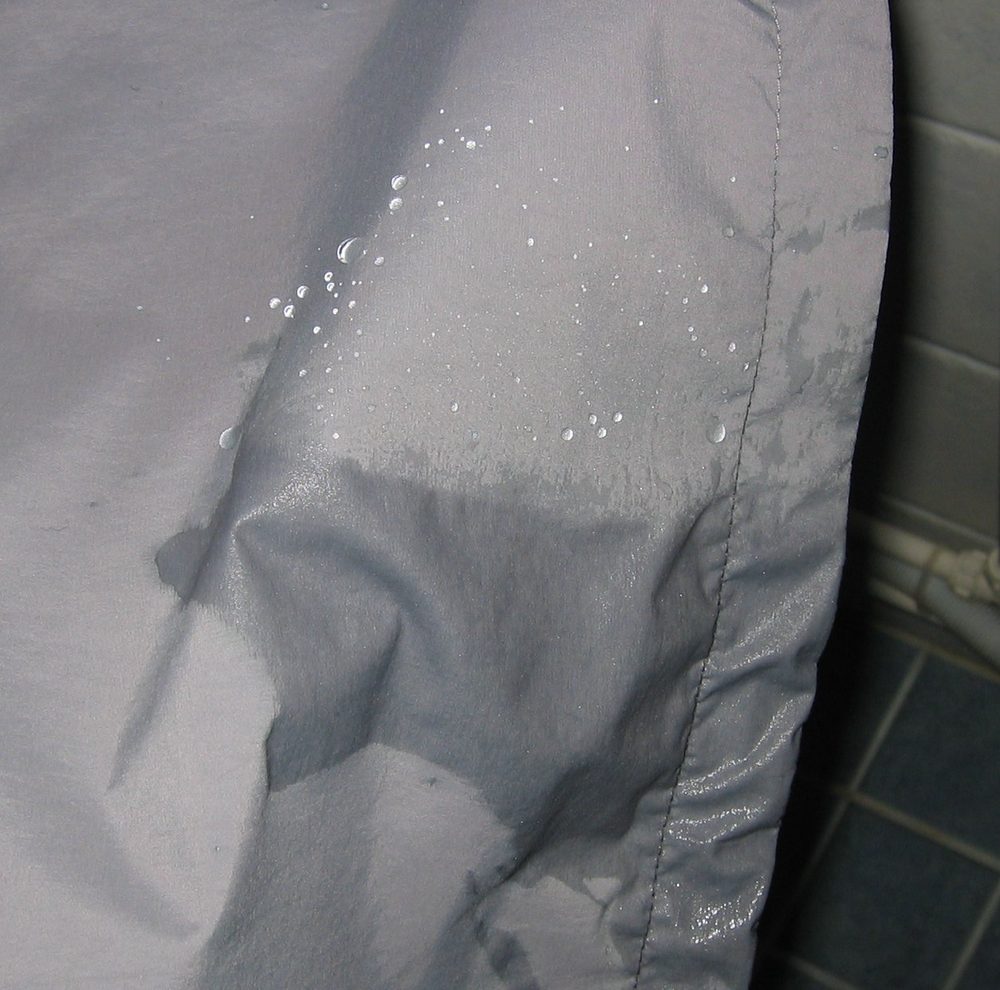
Water beading on a shell jacket, with darker patches where parts of the face have wetted out. Photo: alinja, CC BY-SA 3.0, via Wikimedia Commons; resized.
This is why a waterproof and breathable fabric specification should keep DWR and the barrier together. Hydrophilic films need a dry enough face and a sensible thickness; microporous films or coats need pores that stay open. Raising hydrostatic head by simply adding polymer often lengthens the diffusion path and lowers breathability. The design question is which face, DWR, barrier and backer still feel wearable after the washes and rain hours this garment will see, agreed as methods and conditioning steps, not read from a hangtag number.
The Trap
The common failure in low-price or vaguely written supply is the slogan "waterproof and breathable" with no method behind it. One version is a DWR spray test sold as waterproofing. Another is a heavy, non-microporous coating that can hold water in a short pour test but has no meaningful, method-named vapor transmission. A third is a pair of "10K/10K" figures with no method, no wash state, and no statement of which side was tested.
Those gaps show up later as garments that wet through, coats that peel after washing, or shells that pass first inspection and then feel wet inside in rain. Refuse an unreferenced number, write the method into the purchase sheet, and ask what happens to DWR, hydrostatic head and breathability after the wash standard the brand uses.
Pro FAQ
Is a DWR finish enough to specify waterproof and breathable fabric?
No. DWR helps the woven face shed water. It does not replace a coating or membrane, and a spray rating does not replace a hydrostatic-head method. Without a named breathability method, "breathable" is also just a claim.
Can I compare two MVTR values if both say 10,000 g/m²/24 h?
Not unless they were run to the same method and conditions. JIS L 1099 variants and ASTM E96 cups can produce very different numbers on the same cloth, and MVTR should not be converted to RET by rule of thumb.
When should I stay with a coating instead of a laminate?
Stay with a coating when the end use is light rain or wind, and hand or cost matter more than a durable vapor path. Move to a laminate when the shell must keep a continuous liquid barrier and a usable vapor path as a worn, washed garment.
Does a higher hydrostatic head always mean a better shell?
No. A higher water-column result can come from a thicker, less breathable barrier, a different method, or unwashed fabric only. Match the method to the end use, then check breathability, peel or flex durability, and hand together.
If I need a PFAS-free package, will a fluorine-free DWR last as long as an older C8 finish?
Not automatically. A fluorine-free DWR can be specified, and PFAS-free compliance can be arranged per order, but durability has to be tested to the method you agree. A chemistry name is not a substitute for a wash-conditioned spray rating.
If you already have a shell specification or a reference swatch, send it for a made-to-order feasibility check on a woven polyester or nylon construction.
Reviewed by the Six Dragon Textile technical team — Hangzhou Six Dragon Textile Co., Ltd, one-stop woven apparel fabrics, 22 Years Experience, woven-fabric expertise since 2007, company founded in 2015.
Cover photo: "Drop of water on water-resistant textile (100% polyester)" by Petar Milošević, CC BY-SA 4.0, via Wikimedia Commons. Resized and compressed for web use; shared under the same license.