Which woven fabrics suit for the sportswear
Why Woven Fabrics Are Taking Share in Sportswear
Sportswear has long been associated with knits, but woven fabrics now anchor a growing share of the category: windbreakers, running shells, training shorts, ski wear, cycling jerseys, and warm-up kits all depend on woven constructions. A woven gives you higher tear strength per weight, better dimensional stability, sharper print definition, and a cleaner hand for laminated and coated builds than most knits can offer.
For a sportswear program, the fabric decision usually comes down to four questions: fiber, stretch route, moisture management, and finishing. This guide walks through each one for polyester and nylon wovens — the fibers that dominate performance sportswear — and ends with a spec-sheet checklist you can send directly to a mill.
Start with the Fiber: Polyester or Nylon
Both fibers are strong candidates, and they split the sportswear field by end use:
- Polyester — the volume workhorse. Excellent colorfastness, outstanding printability for team logos and bold graphics, strong UV resistance, and the lowest cost per performance point. Most training wear, jerseys, and printed shorts run on polyester.
- Nylon — the premium option. Softer, smoother hand, higher abrasion resistance, and better flex fatigue. Lightweight outerwear, premium running shells, and packable garments favor nylon.
Both are available in recycled (GRS-certifiable) versions when your brand requires a sustainability story. A quick note on terminology: many buyers ask for a "polyester nylon blend" when what they actually need is a nylon construction with a polyester price point — clarify fiber content and construction separately when requesting quotes.
Moisture Management: Wicking and Quick-Dry
Sweat management in wovens is engineered, not inherited. The fabric has to move perspiration off the skin and spread it across the surface to evaporate. In wovens this is achieved through three routes, often combined:
- Yarn-level structure — profiled filament cross-sections (Y, H, or 4-channel) create capillary channels that pull moisture outward.
- Construction — microfilament plain weaves and lightweight twills increase surface area for spreading and evaporation.
- Finish chemistry — durable wicking finishes applied at the dye house. These wash down over time, so specify wash durability (typically 20–30 home launderings) in your purchase spec.
A practical test protocol: request moisture-wicking and drying-rate results on the exact standard your market uses (AATCC, ISO, or JIS), on the finished fabric — after washing — not on greige. Results are achievable on most polyester and nylon wovens depending on yarn and finish selection, so have the mill quote the test along with the fabric.
Stretch: How Wovens Get There
There are only two ways a woven stretches, and choosing between them drives cost, fit engineering, and care labeling:
- Mechanical stretch — elasticity built into the yarn itself (bicomponent PTT/PET, PBT) or the weave, with no elastane present. Typically delivers comfort-level give in one or both directions, survives high-heat finishing, and keeps costs predictable. See mechanical stretch vs spandex stretch for how the two routes compare.
- Spandex (elastane) stretch — elastane filament inserted in the weft (or warp) for true recovery. The classic sportswear build is 95/5, and the 5% does more than most buyers assume — read what 5% spandex actually does before locking a spec.
If your garment needs genuine two-direction recovery — compression tights, base layers, four-way training shorts — a spandex 4-way build is the only reliable route. Our guide to what 4-way stretch really means in a woven covers what to demand on the spec sheet.
Lightweight Builds: Taffeta, Ripstop, Microfiber
Three woven families dominate lightweight sportswear shells:
| Build | Typical weight | Character | Common use |
|---|---|---|---|
| Polyester taffeta | 50–75 GSM | Crisp, smooth, high print clarity | Windbreakers, lining, printed team shells |
| Ripstop (poly or nylon) | 60–100 GSM | Grid reinforcement stops tear propagation | Training shorts, outdoor crossover, packs |
| Microfiber twill / plain | 80–130 GSM | Peach finish, soft hand, drape | Warm-up kits, casual performance |
Weights outside these ranges exist for special programs; the bands above are where the bulk of commercial production runs.
Durability: What Actually Fails in the Field
Sportswear fabric failures concentrate in four places:
- Seam abrasion — spec Martindale or ASTM D4157 abrasion resistance matched to the garment's friction zones.
- Pilling — filament microfiber builds pill far less than spun yarns; anti-pilling performance is generally achievable on request depending on the yarn and construction selected.
- Color migration and fading — demand wash and crocking fastness grades on your chosen test standard; polyester disperse-dyed constructions generally grade well.
- Coating adhesion — if the fabric is laminated or coated, wet and dry adhesion testing belongs in the spec, not in the complaint file.
Functional Finishes for Sportswear Wovens
Common add-ons, quoted per order and only shown on fabrics where they genuinely apply:
- Water-repellent (DWR) — for shells and shorts; fluorine-free options are now standard when your market restricts PFAS.
- UV protection — tight polyester constructions reach strong UPF ratings; confirm by test on the final color, since depth of shade moves the result.
- Anti-microbial — controls odor in training wear; verify wash durability claims.
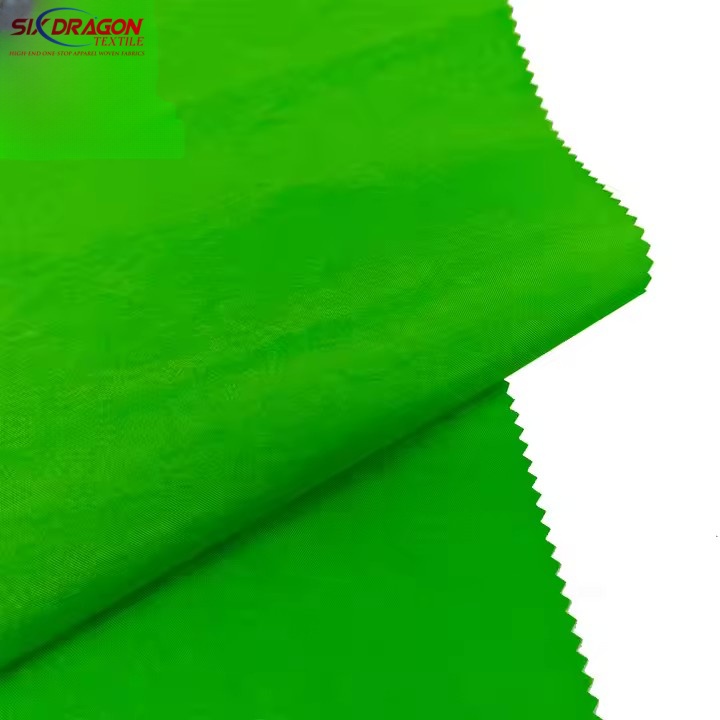
- Calendaring / peach finish — hand modification without chemistry.
Finish performance is always order-dependent: quote the finish and its test standard together, so what arrives matches what was promised.
Spec-Sheet Checklist Before You Order
For the broader sourcing picture — MOQ logic, sampling, and how to audit a supplier — our practical buyer's guide to polyester wovens covers the full workflow. And when you are ready to put real fabric on the table, send us your sportswear program details and we will quote fabric options with the matching test data.
FAQ
Knit or woven for sportswear?
They coexist. Knits win next-to-skin comfort and unrestricted elongation; wovens win tear strength, print sharpness, dimensional stability, and coating compatibility. Most performance wardrobes use both.
Can a woven really replace a knit in training shorts?
Yes — lightweight ripstop and stretch-woven builds with mechanical or spandex stretch are standard in premium training lines, offering better durability and a cleaner look than equivalent knits.
Is recycled polyester performance equal to virgin?
In woven sportswear applications, mechanically recycled polyester from bottle flake performs comparably for most specs; critical-strength programs should verify by test on the actual lot.
What is the minimum order for a custom sportswear woven?
It depends on whether greige is in stock. With stock greige, typical minimums run around 3,000 meters per order with per-color minimums lower; fully custom weaving runs higher. Send us your program and we will confirm the exact structure.