Digital vs Screen vs Sublimation Printing on Polyester Woven Fabric
"How should this print actually be produced?" is a question most buyers answer after the artwork is approved, when the answer has already narrowed itself. On polyester woven fabric, the printing route decides minimum order quantity, colour-count ceiling, achievable detail, lead time, and unit cost — and each route fails in a different way. This guide compares the four routes that cover the overwhelming majority of polyester woven apparel printing.
Why Polyester Prints on Its Own Terms
Polyester is dyed and printed with disperse chemistry. Disperse dyes are hydrophobic and are carried into the fibre by heat, where they dissolve into the polymer itself rather than sitting on the surface. That mechanism produces excellent wash fastness once the fabric is properly washed off and heat-set, and it makes polyester uniquely suited to sublimation — a process that does not work on cellulosic or protein fibres at all.
The practical consequence: on polyester, the print route is a genuine engineering choice with a wide cost spread, not a formality. The same artwork on the same base cloth can be produced at meaningfully different unit costs across the four routes below.
The Four Routes That Matter
Almost every polyester woven apparel print falls into one of four categories:
- Digital direct printing — inkjet directly onto the fabric, no screens, no plates.
- Rotary screen printing — continuous engraved cylinders, one per colour, for high volume.
- Flatbed screen printing — one flat screen per colour, per repeat; suited to panels and placements.
- Transfer and sublimation printing — image printed to paper first, then transferred to the fabric under heat and pressure.
Route 1: Digital Direct Printing
Digital printing removes the setup cost that governs every other route. There are no screens to engrave and no transfer paper to consume, so the cost curve is nearly flat and the viable minimum is measured in hundreds of metres rather than thousands. Colour count is effectively unlimited within the gamut, and design changes between repeats cost nothing but ink.
The trade-offs are real. Ink cost per metre is the highest of the four routes, so digital loses its advantage as volume climbs. Throughput is lower, which matters against tight delivery windows. Colour reproduction also depends on pre-treatment and ink system: screen colour and fabric result diverge unless the mill proofs on the actual base cloth. Digital suits sampling, small capsule ranges, complex multi-colour artwork, and any design still in motion.
Route 2: Rotary Screen Printing
Rotary screen printing engraves one cylinder per colour and runs the fabric continuously beneath them. Setup is significant, but once running the per-metre cost is the lowest of the four routes and the speed the highest. Above roughly a few thousand metres per colourway, rotary is usually the only route that pencils.
The constraints are structural. Cost scales with colour count, so a twelve-colour design carries twelve set-ups. Fine gradients and photographic imagery reproduce poorly; rotary excels at flat colour fields, geometrics, stripes, and repeats. Design changes after engraving are expensive, and repeat length is fixed by tooling — which is why rotary programs are planned at the design stage, not after.
Route 3: Flatbed Screen Printing
Flatbed printing uses the same per-colour screen logic but lays fabric flat for each pass, which makes it the natural fit for cut panels, placements, and all-over prints on shorter runs where repeat flexibility matters more than speed. It handles heavier fabrics and textured surfaces better than rotary, and it allows larger repeats. Its cost structure sits between digital and rotary: less tooling than rotary at scale, more labour per metre than either.
Route 4: Transfer and Sublimation
Transfer printing builds the image on paper first, then drives it into the fabric with heat and pressure. Sublimation — where the disperse dye converts to gas and diffuses into the polyester — is the dominant variant, and it has one property nothing else matches: continuous-tone, photographic, and gradient-heavy imagery without screens, at a lower ink cost than direct digital once volume amortises the paper.
It is also the most fabric-dependent route. Sublimation needs a polyester surface: it will not bond to cellulosic or protein fibres, and blends behave differently from 100% polyester. Base cloth choice, whiteness, and heat-setting history all show through. Registration is excellent because the whole image transfers in one pass, but the paper itself is a consumable and a waste stream that has to be priced in.
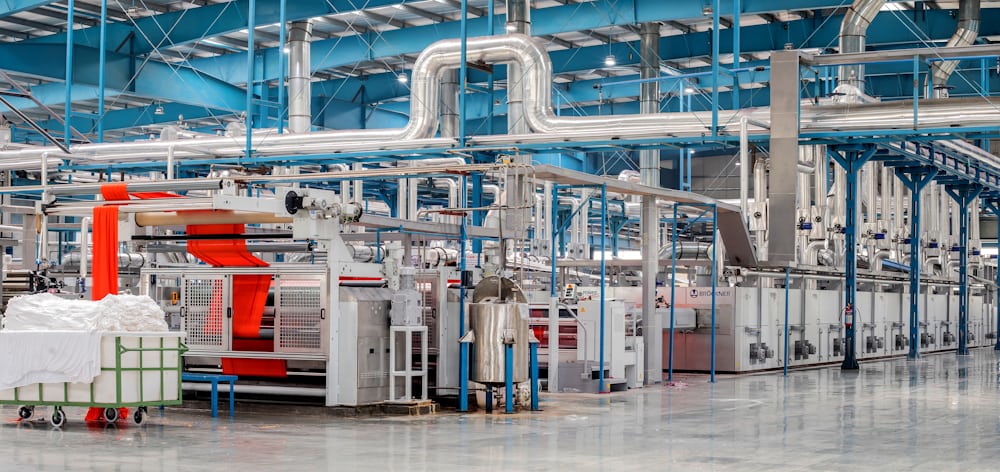
Side-by-Side: The Route Selection Table
| Factor | Digital Direct | Rotary Screen | Flatbed Screen | Transfer / Sublimation |
|---|---|---|---|---|
| Setup cost | None | High, per colour | Moderate, per colour | None, but paper consumed |
| Practical minimum run | Lowest | Highest | Low to medium | Low to medium |
| Unit cost at high volume | Highest | Lowest | Medium | Low to medium |
| Colour count | Effectively unlimited | Costed per colour | Costed per colour | Effectively unlimited |
| Photographic / gradient detail | Strong | Poor | Moderate | Strongest |
| Flat colour fields and geometrics | Good | Best | Very good | Good |
| Repeat length flexibility | Free | Fixed by cylinder | More flexible | Free within paper width |
| Design change after approval | Free | Expensive | Moderate | Cheap |
| Fabric compatibility | Very broad | Broad | Broad, incl. heavier cloth | Polyester surface required |
| Typical best fit | Sampling, capsules, complex art | High-volume repeats | Panels, placements, mid runs | All-over graphics at volume |
Choosing by Order Profile, Not by Preference
Four questions settle the route faster than any technical comparison:
- How many metres, and how many colourways? Under a few thousand metres per colourway, setup-heavy routes rarely pencil. Above that, digital ink cost usually becomes the bigger number.
- How many colours, and how complex? Flat fields and repeats favour screens; gradients, photographic detail, and high colour counts favour digital or transfer.
- Is the design final? If artwork is still moving, the route that tolerates change at near-zero cost should win, even at a higher per-metre rate.
- What is the base fabric? Weight and surface constrain route choice, so the two decisions belong together — see our practical buyer's guide to polyester wovens.
Where the answers conflict, the common resolution is a split program: digital for the capsule and sampling rounds, rotary or transfer for the volume colourways once the design is frozen. That split is routine and, run through one mill, easier to control than it sounds.
Base Fabric Discipline Comes First
No print route can rescue the wrong base cloth. Three preparation points determine the result more than the printing machine does:
- Pre-treatment. Disperse inks need the right surface condition and, in digital routes, a coating or padding step so ink does not wick along the yarn.
- Whiteness and consistency. Base shade variation shows through every semi-transparent print, whatever the ink.
- Heat-setting history. Polyester that has already been set behaves differently under transfer heat, so the sequence of dyeing, setting, and printing must be planned, not improvised.
Weight and construction matter too. A tight, smooth woven carries fine detail better than a loose or textured one, where ink penetration and edge definition change the design's character. How fibre choice interacts with these substrate effects is covered in our polyester versus nylon comparison.
Quality Gates After Printing
Printed fabric should be released against written criteria, not a visual impression on the table:
- Colour fastness to washing, rubbing, and light — tested to the standard your market requires, on the finished fabric rather than the greige.
- Registration and repeat — alignment across the width and across the run, not only in the first metres.
- Ink penetration and strike-through — whether the print reads the same on both faces, which matters for unlined garments.
- Handle and stretch effect — printing changes drape, and on stretch bases it interacts with the recovery behaviour described in our guide to 4-way stretch wovens.
Acceptance tolerances are programme-specific — they depend on the standard, end use, and base fabric, and belong in writing before bulk; see our comparison of mechanical and spandex stretch routes for how criteria shift with construction.
Common Buyer Traps
Trap 1: Approving artwork and pricing it before the route is fixed. The same design can differ by a wide margin between digital and rotary at volume. Fix the route, then price.
Trap 2: Choosing digital for a program certain to scale. Digital is right for sampling and for designs still in motion. If the design is frozen and volume known, the setup-higher route is usually cheaper per metre.
Trap 3: Sending artwork without a physical strike-off on the base cloth. Nothing replaces a print on the actual fabric, in the actual ink system, at production speed.
Where Six Dragon Textile Fits
We weave polyester and nylon wovens and manage printing through long-standing partner print houses, so digital, rotary, flatbed, and transfer routes are all available against the same base cloth — alongside dyeing, functional finishing, and the stretch options covered in our sportswear woven guide and casualwear woven guide. Base weights, widths, and performance parameters are available on request and quoted to your specification rather than published as fixed values. If you are deciding between printing routes, send us the artwork type, colour count, target quantity, and base fabric and we will quote the routes that fit the order. For the functional end of the range, see our outdoor woven guide.
Pro FAQ
Which printing method is cheapest for polyester woven fabric?
It depends on volume and colour count. Digital has no setup and wins at low volume. Rotary screen has the highest setup and the lowest per-metre cost, so it wins at high volume with limited colours. There is no single cheapest route.
Can I use sublimation printing on every polyester fabric?
No. Sublimation needs a polyester surface and behaves differently across constructions, weights, and blends. The base cloth must be confirmed before the route is committed.
How many colours can digital printing reproduce?
Effectively unlimited within the ink set's gamut — there are no per-colour screens. The practical limits are proofing accuracy and achievable colour depth on that substrate.
Does printing change the hand of the fabric?
Yes. Ink, pre-treatment, and finishing all shift drape and surface feel. Printed hand should be assessed on a strike-off, not extrapolated from the greige.
What should I include when requesting a print quotation?
Artwork type and colour count, target quantity per colourway, base fabric specification, end use, and the fastness standards the market requires.
The printing route is far cheaper to fix before sampling than after. Settle the base cloth and the order profile first, then let the route follow from them rather than from habit. To compare routes against a specific program, send over the details and we will quote each viable method side by side.