Yarn Twist and Twist Direction in Woven Polyester and Nylon: S and Z, Crepe, Bulk and Specification Writing
Two woven fabrics can share the same polymer, denier, ends and picks, and still behave like different cloth. The variable most often left off the specification is yarn twist: how many turns go into the filament bundle, and in which direction. Twist sets handle, cover, lustre, shrinkage and seam behaviour before any finish is applied. This article explains what to specify and what to confirm on a sample.
Why Twist Is a Specification, Not a Mill Detail
A yarn line naming only denier and filament count leaves much of the fabric undefined. Twist is decided at the texturing or twisting stage, locked into the warp beam, and carried unchanged through dyeing and finishing. Changing it later is not a finish adjustment; it is a different yarn, a different beam and a new approval.
Buyers usually feel the result first, as an unexplained difference in drape or surface, then struggle to name it in a claim. Writing twist into the order turns a subjective hand into an agreed, checkable variable. The filament yarn specification guide covers the rest of the yarn line, including FDY, DTY and filament count.
What Twist Level Measures: TPI, TPM and the Twist Factor
Twist level is counted as turns per inch (TPI) or turns per metre (TPM). Raw turns alone mislead: the same 800 TPM binds a fine filament bundle tightly and a heavy one barely at all, because each turn acts over a different yarn circumference.
A twist factor normalises turns against the square root of linear density, so yarns of different denier compare on one scale. The coefficient varies with the count system used by the mill, so request both the turns and the factor. Treat any figure as indicative and confirmed per order, available on request.
S and Z: Direction, Ply and the Twill Line
Hold a yarn vertically and read the tilt of its surface filaments. A tilt following the middle stroke of an S is S twist; one following Z is Z twist. Single filament yarns are normally Z twisted, while folded or plied yarns usually reverse direction at the plying stage, giving a Z-on-S or S-on-Z structure.
Direction matters most where the weave has a diagonal. The same right-hand twill built on Z-twist warp reflects light differently from one built on S-twist warp, so two cloths with identical construction can read as different fabrics. Which combination looks sharper depends on whether warp or weft dominates the face; confirm on an approved sample. The weave selection guide compares twill and crepe structures.
High Twist: Crepe, Chiffon and a Dry Handle
High twist compacts the bundle, stores torsional energy and produces the crisp, dry handle associated with crepe and chiffon constructions. When the cloth is wetted and heated in dyeing, that stored torque releases, the yarns contract unevenly and a fine, irregular surface appears. The effect is engineered at the yarn stage, not printed or embossed on afterwards.
The same torque has a cost. A strongly twisted warp can drive skew, bow and edge curling, and the cloth relaxes differently in width and length. The width and grain guide explains why bow and skew are measured on finished cloth, and the heat and care guide covers the setting window that fixes the fabric. Both limits are confirmed per order.
Low Twist and Textured Yarn: Bulk, Cover and Softness
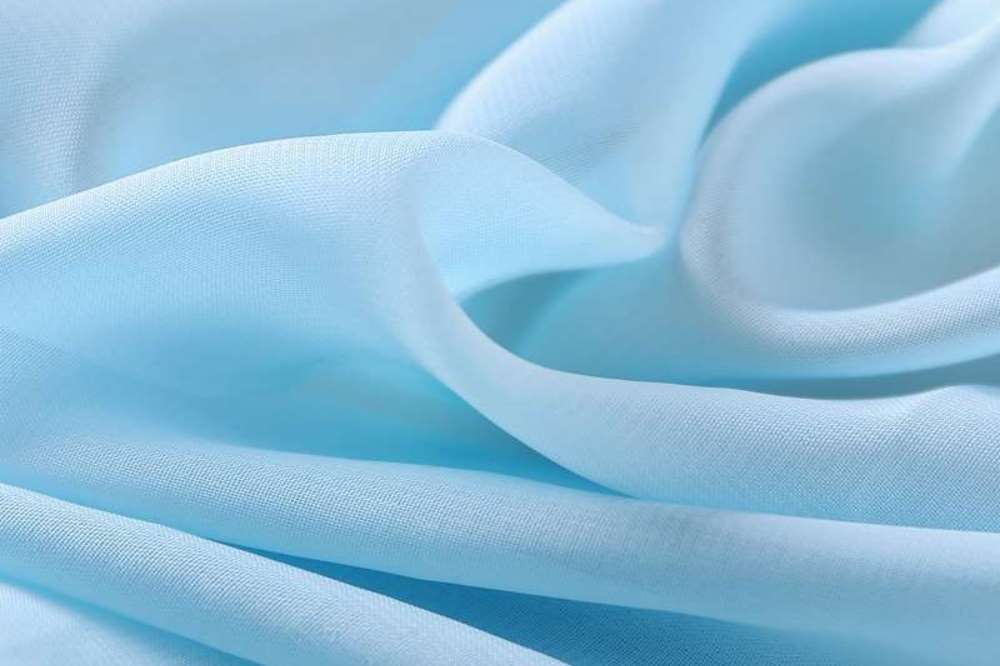
At the other end, low twist and textured filament yarns keep the bundle open. DTY and air-textured routes add crimp and loft between filaments, so the yarn occupies more space at the same denier. The cloth gains bulk, coverage and a softer hand, which suits lightweight shells, relaxed outer layers and programs where opacity matters more than a crisp surface.
The trade is mechanical. Open, low-twist bundles have less cohesion, so they can snag, shed fibrils and lose effective strength at the same construction. Finishing can amplify the softness, as the hand-feel routes guide shows, but it cannot restore the cohesion that was never put into the yarn. Specify the yarn route before specifying the finish.
Torque, Skewness and Relaxation Shrinkage
Twist energy does not disappear when the yarn is woven. It stays as latent torque until heat and moisture let the structure relax, which is why a high-twist fabric can change width, skew or curl between greige and finished state. Heat setting at a long-term partner mill arrests that relaxation inside a controlled window.
This is a specification issue, not only a processing one. Relaxation shrinkage and residual torque should be measured on the finished article and written into the tolerance, using the test report guide for shrinkage and dimensional results. Greige and finished readings are not interchangeable; the two-stage inspection article explains which faults each stage can actually see. Values are confirmed per order.
How Twist Changes Dye Uptake and Surface Appearance
Twist changes how tightly filaments pack, and that changes how a dyebath or print paste reaches the yarn interior. A compact high-twist bundle resists penetration and reflects light sharply; an open textured bundle takes up liquor more readily and reads softer in depth. Two fabrics dyed to the same recipe can therefore differ in apparent shade.
This is one reason a lab dip approved on one construction cannot be transferred blindly to another with a different twist level. The polyester dyeing guide walks through pretreatment and reduction clearing, and the shade approval guide shows how lustre and surface change the reading under a light source. Assess colour on the approved construction, not a substitute.
Strength, Abrasion and Seam Behaviour
The relation between twist and strength is not monotonic. Moderate turns bind filaments and raise effective tenacity; beyond a practical ceiling, extra turns add torque, reduce axial alignment and can lower strength while making the surface harder and more abrasive. Abrasion and pilling behaviour shift on the same axis.
Smooth, highly twisted filament yarns also slide past one another more easily, which raises seam slippage risk in lightweight constructions. The seam behaviour article sets out the test methods and the density and finish levers that control it. When a program needs both a dry handle and seam integrity, density and weave have to carry part of the work; see the ends and picks article.
Choosing a Twist Route by End Use
The table compares routes. It is not a set of fixed values: handle, cover and shrinkage depend on construction and finishing, and are confirmed per order.
| Yarn route | Handle and cover | Main risk | What to write into the order |
|---|---|---|---|
| Low twist, textured | Soft, bulky, high cover | Snagging, low cohesion, slippage | Name texturing route, denier, filament count, twist level |
| Conventional Z twist | Balanced, stable, moderate cover | Limited loft | State TPI or TPM and direction for warp and weft |
| High twist, crepe | Crisp, dry, fine crepe surface | Torque, skew, relaxation shrinkage | Set twist factor, setting window, finished skew tolerance |
| High twist, balanced ply | Dry handle, reduced torque | Cost, plying lead time | Specify ply construction and direction at each stage |
| S-twist warp variant | Altered twill definition and lustre | Face-dependent appearance | Approve on a sample before bulk |
| Mixed twist, warp vs weft | Contrast surface effects | Differential shrinkage | Lock both yarn lines in one specification |
Writing Twist into the Specification: A Seven-Line Clause
A workable clause names the yarn, the direction and the acceptance point, without promising fixed values.
- State polymer and yarn route — FDY, DTY, ATY or plied, separately for warp and weft.
- Give denier and filament count alongside the yarn route, using one consistent count system.
- Name twist level in TPI or TPM, plus the twist factor and the count system used.
- Name direction — S or Z for singles, and the direction at each plying stage.
- State weave direction where a diagonal is visible, and require an approved sample.
- Set finished-state tolerance for width, bow, skew and relaxation shrinkage, confirmed per order.
- Fix the approval sequence — greige, dyed or finished sample, and sign-off before bulk.
Frequently Asked Questions
Can twist be changed after the cloth is dyed?
No. By that point the yarn is fixed in the construction and the surface has already relaxed. A different handle means a different yarn, a new beam and a fresh shade approval, which the lead time article shows is a schedule cost, not a finishing option.
Why does the same denier fabric feel different between two suppliers?
Twist level, texturing route and filament count are usually the missing variables. Ask for TPI or TPM, the twist factor and the yarn route. Without them, denier describes mass per length and says almost nothing about handle or cover.
Does high twist always mean better strength?
No. Strength rises with twist only up to a practical ceiling, then torque and reduced filament alignment work against it. Beyond that point a harder surface and greater shrinkage risk are more likely than a stronger cloth. Confirm on a tested sample.
Should S and Z be written separately for warp and weft?
Yes, where the face is a twill or the program uses mixed effects. Warp and weft directions determine how the diagonal reads and how the cloth relaxes. Record both lines in the specification and approve the combination on a sample.
Specify the Yarn Before the Cloth
Send the polymer, denier, filament count, yarn route, twist level and direction together, and we can quote woven polyester and nylon programs against a specification that reproduces the handle you approved, with dyeing and finishing at long-term partner mills. Start with the inquiry form, and read the polyester and nylon comparison before fixing the fibre family. For context, the GSM guide, the nylon ripstop article, the warp sizing guide and the quotation breakdown cover construction, preparation and cost. If an earlier program changed hand between sample and bulk, tell us which yarn line changed in your first message to us: a twist change, a texturing change and a finish change need different fixes.